Beyond Linear Growth: Understanding Montessori's Four Planes of Development

Trees start out small and generally keep their form as they grow progressively bigger and stronger. Children, however, change so dramatically as they develop. Think about the remarkable transformations that happen from a newborn baby to a running toddler, to a primary child reading their first words, to an adolescent driving a car. They almost do not seem like the same being as when they began.
Prior to the mid-1800s, human development was largely viewed as linear. A child was considered a smaller adult who simply grew older and bigger over time. As the field of psychology grew, researchers realized that humans pass through a sequence of distinct stages at different ages. This understanding of development as a progression became known as Stage Theory.
The Origins of Stage Theory
Stage theories were widely explored during the time Dr. Maria Montessori was developing her pedagogy. These theories break human development down into distinct stages assigned to specific age ranges. The core idea is that specific characteristics, abilities, and innate developmental powers emerge during each stage to help individuals progress.
Additionally, stage theories imply a necessary sequence. The accomplishments of one stage become the foundation for the next. During the late 19th and early 20th centuries, several prominent thinkers explored this concept:
- Jean-Jacques Rousseau proposed an educational system formulated around specific stages of life and the unique characteristics of each age.
- Sigmund Freud focused on personality formation, believing early childhood was the most critical period.
- Erik Erikson, who earned a Montessori teaching certificate, proposed eight distinct stages centered on psychosocial development.
- Jean Piaget outlined four stages of cognitive development in children.
- Lawrence Kohlberg expanded on developmental stages with a focus on moral reasoning.
Dr. Montessori’s Model: The Planes of Development
While Dr. Montessori was aware of these theories, her approach differed in a profound way. Rather than focusing on a single aspect of human growth such as cognitive skills or personality, her framework was holistic. It integrated physical, social, emotional, and intellectual development into a unified vision of the child.
Dr. Montessori called her framework the "Planes of Development." She identified four distinct six-year periods of growth:
- First Plane (Birth to Age 6): The Absorbent Mind (Infancy and Early Childhood)
- Second Plane (Ages 6 to 12): The Reasoning Mind (Childhood)
- Third Plane (Ages 12 to 18): The Humanistic Mind (Adolescence)
- Fourth Plane (Ages 18 to 24): The Specialized Mind (Adulthood)
Dr. Montessori observed that the shifts between these planes were so dramatic that they resembled a metamorphosis. The child who enters a new plane emerges transformed, with entirely new psychological needs, capabilities, and ways of interacting with the world.
As Dr. Montessori wrote in The Four Planes of Education:
"The child does not grow in a uniform way day by day, at the same rate. In growth there are crises, somewhat like the metamorphosis of the insects. In fact, it is the child himself who will be the guide of education."
Characteristics of the First Plane at Northwood
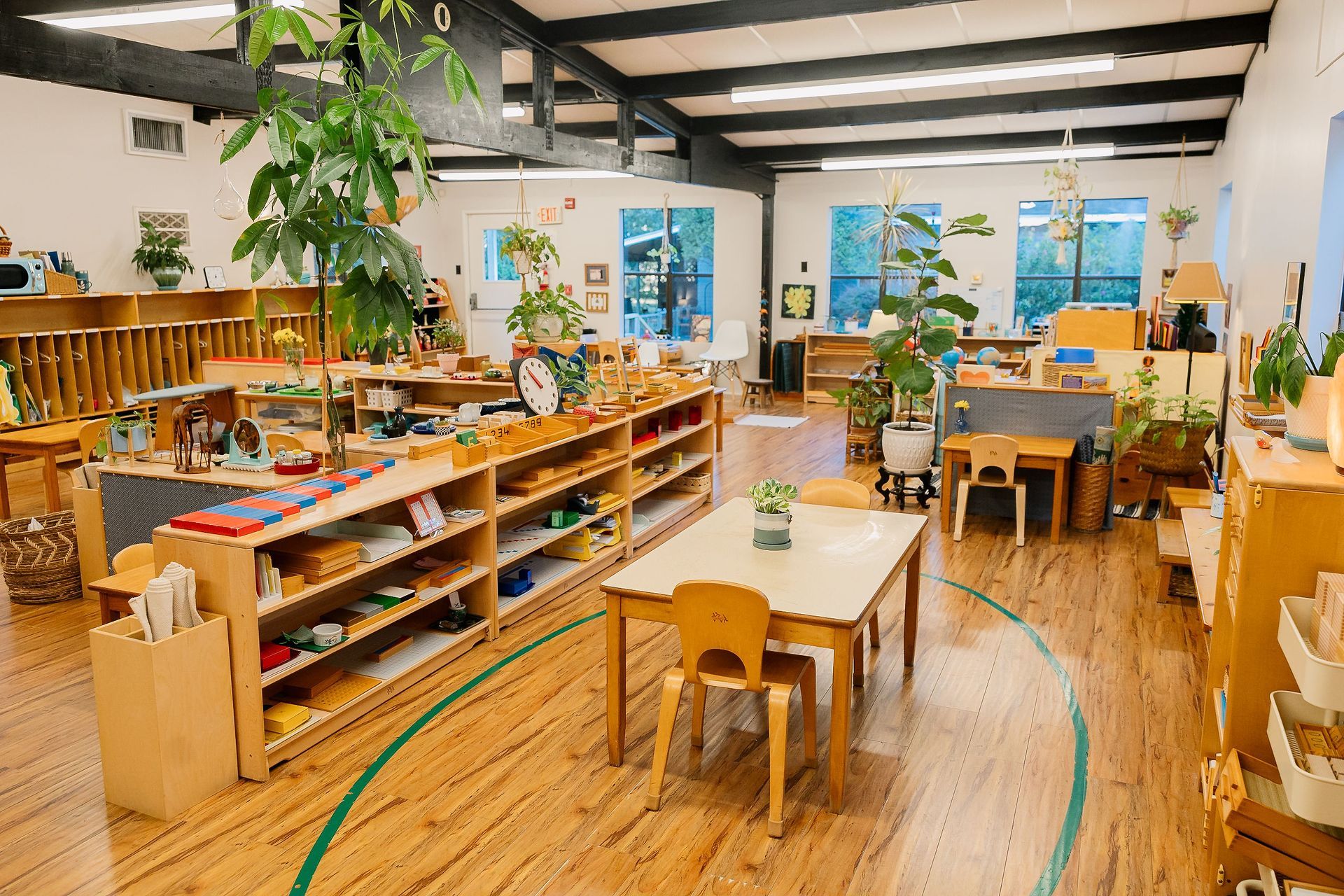
At Northwood Montessori School, our work with Houston families focuses specifically on the First Plane of Development, serving children in our Toddler (ages 18 months to 3 years) and Primary (ages 3 to 6 years) programs.
During this first plane, children possess what Dr. Montessori called the "Absorbent Mind." They effortlessly absorb language, culture, sensory details, and social norms directly from their environment. This period is marked by a deep drive for physical independence, refinement of movement, and the order required to make sense of the world around them.
Because each plane has distinct characteristics, the environment must adapt to meet the specific needs of that age. The successful construction of the self during these early years creates the foundation for all future learning.
Montessori’s Unique Contribution
Dr. Montessori set her work apart in three key ways:
- Universal Observation: She identified universal human tendencies that apply to children across all cultures and backgrounds.
- Focus on Normalization: She focused on supporting natural, healthy development rather than studying developmental deficits.
- Prepared Environments: She did not just theorize about development. She created practical, beautiful environments, specialized materials, and precise teaching methods designed specifically to serve each stage of growth.
At Northwood, everything in our environments is chosen with deep respect for where your child is right now. We understand that early childhood is not a waiting room for adulthood. It is a distinct, crucial stage of self-construction.
We invite you to
schedule a tour of our campus to see how our Toddler and Primary classrooms are carefully prepared to honor and support your child's natural stage of development.
You might also like