Materials Spotlight: Miniature Environment and the Grammar Boxes
We love grammar! This probably doesn’t come as any surprise, considering we work at a school. In our humble opinion, Montessori grammar materials are so beautiful, and they do a great job of drawing kids in to learn about something many of us dreaded when we were kids ourselves.


It all begins in the final year of primary or the first year of lower elementary, with a sweet introduction to the miniature environment.


The Miniature Environment/Function of Words

Traditionally, the miniature environment consists of a replica barn, complete with tiny toy animal figures, although some Montessori schools today have strayed from the original farm and created other environments.


When we think of grammar and six-year-olds, the goal is to let them graze. We don’t expect mastery. We want to introduce concepts in a way that is light and fun and makes them want to engage.


This is where the farm animals come in.


Nouns are naming words, and six-year-olds are often still developing their reading skills. It’s so much fun for them to match labels to animals as they name cow, sheep, chicken, and even fence, barn, farmer. As time goes on, we introduce the concept of articles, and how their function is to introduce the noun. The cow, a sheep, an ox. Tiny paper labels lie alongside the figures as the child works. This progresses through all the parts of speech: adjectives, verbs, prepositions, adverbs, pronouns, conjunctions, and finally, interjections.


The Grammar Boxes

Of course, there’s more to grammar than adorable toy animals. In the second year of lower elementary, and extending into the third year, children use the grammar box materials. The grammar boxes consist of wooden boxes containing cards with words and phrases, sectioned trays to lay the cards in, and open-topped containers with larger index-sized cards.


We start with the latter, which are called command cards. As with the functions of words lessons, these progress through the different parts of speech. The command cards direct children to physically do specific things. “Throw the eraser out the door” is a crowd favorite. This is one exciting way Montessori turns language work into something more hands on and participatory.


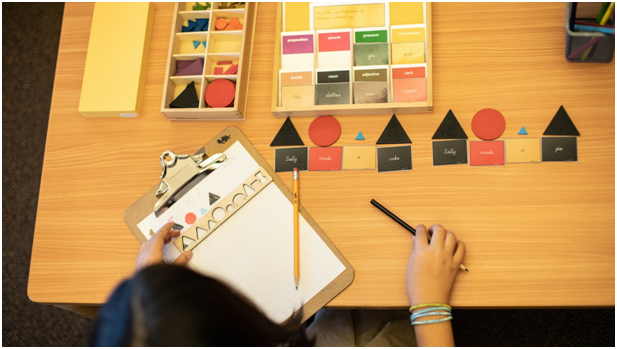
Once they’ve worked their way through the command cards, children engage with the filling boxes, recreating phrases and sentences and identifying the various parts of speech.


At some point, the children learn the corresponding symbols for each part of speech (some are seen above in the picture), and they become able to write sentences in their notebooks and draw the correct labels above each word.


The grammar boxes are typically completed sometime during the final year of lower elementary, although upper elementary teachers may choose to use the material for review purposes.


Sentence Analysis

Montessori sentence analysis is not the same as the sentence diagramming some of us did when we were younger, but it is based on some of the same concepts.


At this point in a child's Montessori career, they are beginning to move toward what we call abstraction. That is, they are beginning to internalize concepts in a way that doesn’t require them to use hand-held manipulatives or materials nearly as often. This is obvious in that the sentence analysis materials are still moveable, but there’s a lot less to interact with. A series of wood circles and arrows, they help the child learn concepts like subjects and predicates.


Eventually, sometime in upper elementary, children explore all kinds of sentence analysis concepts, like indirect objects and adverbial extensions.


Want to learn more about the Montessori language curriculum and materials? Keep an eye on our blog as we highlight more throughout the school year.

You might also like
By Dolores Vazquez January 14, 2026
Returning to school after winter break presents a meaningful opportunity to re-establish rhythm, routine, and independence for children. In Montessori education, transitions are approached with patience, respect for development, and thoughtful preparation of the environment. January offers a natural reset; allowing children to regain momentum and rebuild the concentration and confidence that come from purposeful work. Re-establishing Rhythm After the Holidays Young children thrive when their days follow predictable patterns. Breaks from school are joyful and family-centered, yet they often bring irregular schedules, travel, or disrupted sleep routines. As children return to the classroom in January, they may temporarily show signs of disorganization, lower concentration, or increased emotional sensitivity. From the Montessori perspective, this is expected. The prepared environment, with its order, consistency, and carefully sequenced materials, provides the grounding children need to return to purposeful activity. Very quickly, they remember the flow of the work cycle, the expectations of the community, and the independence that is built into every part of the day. How Montessori Classrooms Reinforce Independence in January Practical Life: The Foundation of Independence Practical Life materials are central during post-break transitions. Children are naturally drawn back to these exercises because they offer structure, clarity, and purposeful movement. Activities such as pouring, sweeping, food preparation, and care of the environment help children regain equilibrium while strengthening coordination and concentration. Grace and Courtesy Renewed January is an ideal time for revisiting Grace and Courtesy lessons, small demonstrations that teach children how to interact respectfully within their community. These lessons help reset expectations and reinforce peaceful problem-solving, kindness, and cooperation. Choice and Uninterrupted Work Cycles Children return to long, uninterrupted periods of concentration. The freedom to choose meaningful work allows them to re-engage at their own pace, restoring the satisfaction that comes from self-directed activity. Strategies Parents Can Use at Home Resetting the Home Environment Simple adjustments can empower children to become more independent after the holiday break. Consider: A consistent place for shoes and coats Low hooks and shelves for belongings A small snack station with accessible containers Child-sized tools for cleaning and organizing These changes mirror the Montessori prepared environment and help children feel capable and confident. Consistent Routines Re-establish a predictable morning and evening sequence: Prepare clothes the night before Use a visual routine chart if helpful Keep wake-up and bedtime consistent Children feel more secure when they know what to expect. Supporting Emotional Transitions Transitions take time. Montessori emphasizes calm, respectful communication. Offer empathy, pause before assisting, and encourage your child to try tasks on their own before stepping in. Simple Montessori-Aligned Activities to Build Independence Folding washcloths Watering plants Helping prepare breakfast or snacks Sorting laundry Organizing winter gear and outerwear These tasks develop coordination, responsibility, and confidence while fostering meaningful participation in family life. Supporting Independence at Northwood Montessori At Northwood Montessori, we see January as a fresh opportunity to strengthen independence, re-establish routines, and honor each child’s natural desire for purposeful work. Through the prepared environment, skilled guidance, and respect for each child’s developmental rhythm, we help children transition back into the school community with confidence and joy.
Montessori parent and child painting together, sharing connection, and quality time through play
November 24, 2025
Discover how just 10 minutes of “Special Time” can transform your child’s behavior and strengthen connection through love, presence, and play.
More Posts