Unlocking the Power of Language
We all know that reading is much more than just decoding words. When we understand and appreciate the full meaning behind words, phrases, and sentences, reading can transport us in powerful ways.
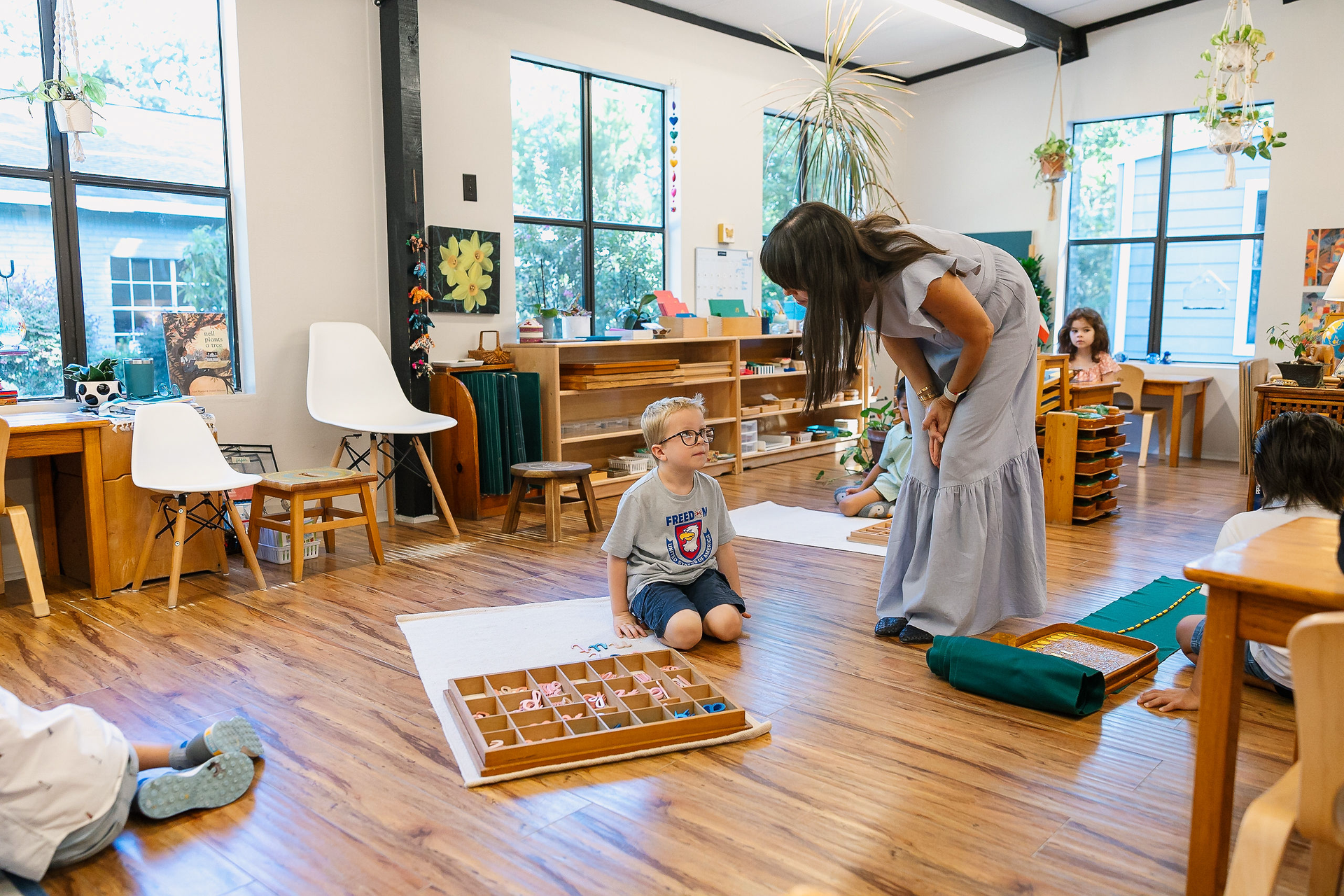
In our classrooms here at Northwood Montessori School, we support young children’s deeper understanding. One way we do this is through a set of activities called the Function of the Word exercises.
At first glance, these exercises may appear to be grammar lessons, but they serve a distinctly different purpose. They are actually reading activities designed to help children explore how language works and to do so in a joyful, hands-on, and developmentally appropriate way.
Why Do These Exercises Matter?
Children around age 4½ to 5 are in the midst of what Dr. Maria Montessori identified as a Sensitive Period for Language. During this time, they naturally begin experimenting with grammar, word order, and expression. The Function of the Word exercises tap into this innate curiosity by offering playful and engaging opportunities to explore how words function within a sentence.
These lessons are full of movement and drama. When a child reads something like “jump and sing a song” and gets to act it out, they are having fun and actively building the foundation for what we call “total reading.”
Total Reading
We want children to move from decoding into “total reading,” which is when they can comprehend and interpret the meaning of written text, including understanding the author's intent, emotions, and the overall message conveyed. This is when children go beyond basic decoding skills and integrate various components of reading to achieve a holistic understanding.
In essence, total reading is the complete comprehension and interpretation of the thoughts and ideas presented in a written text. It's not just about recognizing the words on the page, but about understanding what those words mean and how they connect to the larger message.
From Words to Sentences: A Natural Progression
The Function of the Word exercises provide children with increasingly longer phrases to read, and eventually lead up to sentences. A sample progression is as follows:
Example exercises of the Noun Family:
- 1 word (noun): horse
- 2 words (noun and article): the horse
- 3 words (noun, article, adjective): the brown horse
- Phrase (with conjunction): the brown horse and the spotted cow
- Phrase (with preposition): the brown horse and the spotted cow in the pasture
The best part is that as children read these words and phrases, they find the figurines to set up the scene.
Example exercises of the Verb Family:
- 1 word sentence (verb): gallop
- Short sentence (verb and adverb): gallop swiftly
Children love experiencing how verbs bring life to a sentence! They act out the sentences and delight in experimenting with how adverbs change the action.
Through this kind of progression, children begin to understand how words build on each other to create meaning.
Making Language Visual and Hands-On
In Montessori, we also use symbols to represent each part of speech. Using color-coded symbols provides children with a sensorial impression of the different functions of words and how they relate to each other. Children also begin to visually identify syntactical patterns.
- Noun: large black triangle
- Article: small light blue triangle
- Adjective: medium blue triangle
- Conjunction: pink bar
- Preposition: green crescent
- Verb: large red circle
- Adverb: small orange circle
Using these symbols, children can build and manipulate sentences. They play games where they switch the order of words to explore how syntax changes meaning. Imagine the giggles when children realize how different “the man on the horse” is from “the horse on the man”!
Oral Language Games
Before reading and symbol work, each function is introduced through spoken games. Here are a few examples you can try at home:
- Article Game: Ask your child for “the ball” (a specific one) or “a ball” (any ball). See if they can tell the difference!
- Adjective Game: Ask for “the pencil,” but don’t specify which one. Then say, “I meant the red pencil, but I didn’t say red. How did you know?”
- Conjunction Game: Name a group of objects using “and,” such as “a spoon, a cup, and a plate.” Play around with omitting the conjunction.
- Preposition Game: Use simple commands like, “Put your hands behind your back” or “Put the napkin under your legs.”
- Verb and Adverb Game: Give playful commands like “Jump quickly,” “Walk slowly to the door,” or even a three-part task: “Say hello to your teddy bear, hop to the kitchen, and touch the blue chair.”
These games can be fun time-fillers while waiting for others, an appointment, or your turn in line. Plus, they help children internalize the beauty and power of language in meaningful, developmentally aligned ways.
A Joyful Journey Toward Literacy
It’s important to note that in the preschool years, we don’t introduce children to grammatical terms (this comes later in Montessori elementary classrooms!). The goal isn’t to memorize parts of speech, but to explore language playfully and deeply. Through repeated, engaging, and sensorial experiences, children begin to read with understanding, emotion, and appreciation.
Schedule a visit to Northwood Montessori School here in Houston, Texas to see how Montessori provides a true foundation for lifelong literacy.
You might also like