The Miraculous Journey of Early Language Development
Our ability to communicate through spoken language is a defining characteristic of what makes us human. Language binds our communities together, allows us to share our internal worlds, and gives us the collaborative power to build culture.
In the Montessori philosophy, we recognize language as an innate human tendency. This powerful developmental force begins long before birth and shapes the architecture of the child's mind.
At Northwood Montessori School, we have supported Houston families since 1975 by honoring these natural developmental milestones. Understanding the predictable trajectory of speech helps us better support our youngest children as they transition into our Toddler environments and prepare for the Primary years.
Prenatal Development through Birth
A child's language journey begins in the womb. The auditory system starts functioning remarkably early, and a fetus is capable of listening to sounds around 13 to 14 weeks of gestation. Speaking, reading, and singing to an unborn baby provides vital opportunities to hone their early auditory skills. It also establishes familiar, comforting points of reference that the baby will recognize immediately after birth.
Newborns show a distinct preference for human voices over other environmental sounds, with a special attunement to their mother's voice. A infant's brain is naturally wired to discriminate and categorize diverse speech sounds, laying the groundwork for the spoken language of their specific culture.
Two to Three Months: Early Experimentation
During the first few weeks of life, a baby’s cry serves as their primary tool for communication. By two or three months, biological maturations allow them to begin modulating these vocalizations.
Between three and four months of age, babies enter a delightful phase of vocal experimentation. They begin cooing, gurgling, and eventually babbling. They produce pure vowel sounds with an apparent sense of joy.
As the adults in the child's life, our role during this phase is to respond to these sounds with genuine interest. By treating these early vocalizations as intentional conversation, we create a back-and-forth dialogue that encourages the child to continue communicating.
Five to Seven Months: Playing with Sounds
As physical coordination improves, babies begin introducing consonants into their speech play, eventually chaining syllables together. Between five and seven months, they are no longer just expressing their physical states. They are actively experimenting with the mechanics of sound production.
By seven or eight months, distinct syllables emerge in their babbling, and by the end of their first year, their vocalizations take on an inflection that mimics the rhythm of actual sentences.
During this stage, children also realize that specific sound combinations elicit joyful responses from adults. They begin to recognize patterns in the stream of spoken language around them. By nine months of age, a baby can hear and remember specific sequences of sounds, realizing that these patterns carry meaning.
Nine to Twelve Months: Intentional Communication
From nine to twelve months, infants enter a highly active period of language absorption. They begin identifying distinct words within conversation, remembering units of sound, and attempting their first spoken words.
During this phase, a child's receptive language, which is their ability to understand speech, is significantly more advanced than their expressive language, or their ability to produce words. A child may use a single word repeatedly to communicate a wide variety of needs or observations.
When we slow down and respond thoughtfully to these early attempts, we legitimize the child's efforts and empower them to keep trying.
"Babies at nine months whose mothers followed the baby’s lead, who responded to what the baby was interested in, had larger comprehension vocabularies at thirteen months." - How Babies Talk: The Magic and Mystery of Language in the First Three Years of Life
12 Months and Beyond: The Language Explosion
The period between 12 and 20 months is marked by steady, deliberate vocabulary growth. While the acquisition of words might seem slow at first, it builds toward a profound developmental tipping point. Once a toddler builds a vocabulary of roughly 50 words, their language development takes flight in what educators call the language explosion.
After 20 months, the child begins adding hundreds of new nouns, verbs, adjectives, and prepositions to their vocabulary. A child at this stage learns new words at an astonishing rate, averaging approximately nine new words a day.
Their phrases lengthen, syntax rules are absorbed naturally, and they begin the cognitive work of sorting and categorizing. They realize that the word "dog" applies to the family pet, a picture in a book, and a neighbor's dog down the street.
Between 18 and 24 months, toddlers use simple sentences to express their emotions, needs, and identities. A significant milestone occurs when the child begins referring to themselves in the first person, using "I" or "me" rather than their own name in the third person.
Supporting the Absorbent Mind
While every child develops at their own individual pace, this general pattern of language acquisition is universal. Humans are biologically driven to connect and collaborate.
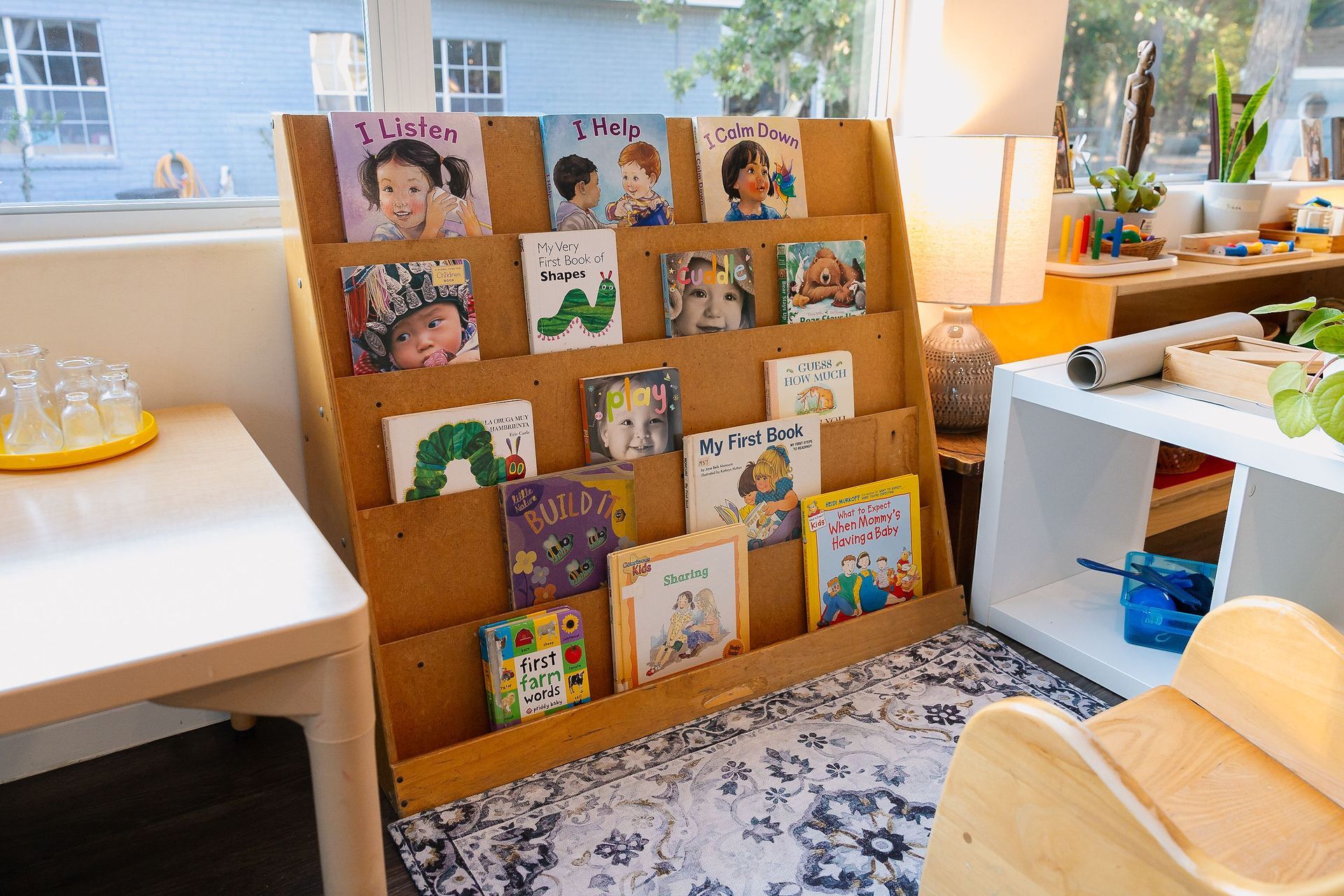
The linguistic environment we provide during the first three years of life is foundational. In our AMI Montessori Toddler environments, we support this developmental stage by speaking to children clearly, using precise vocabulary, offering rich storytelling, and listening with deep respect when they speak to us.
We invite you to
schedule a visit to our Houston campus to see our beautifully prepared, language-rich environments in action.
You might also like